With research and reports into the gummy market showing a compound annual growth rate (CAGR) of almost 12%, it’s predicted that demand will continue to increase over the next decade. Consumers are moving away from traditional tablets and pills, and instead they are seeking convenient, palatable alternatives for health and wellness products.
From vitamins and minerals to botanical extracts and probiotics, manufacturers are under pressure to deliver products that are both appealing and do what they say on the tin. Yet the challenge of achieving stable active ingredient pectin gummies is one of the most technically demanding parts of manufacturing.
We explore processing factors that affect ingredient stability in pectin-based manufacturing, and how the right equipment use can be the difference between a product that hits the mark and one that falls flat.
What Are the Challenges of Using Pectin as a Gelling Agent
Pectin has become the gelling agent of choice for plant-based and clean-label gummy products. Gelatin is derived from animal collagen, whereas pectin is a naturally occurring polysaccharide extracted from fruit, making it well suited to the growing market for functional gummies that align with dietary and ethical consumer choices.
However, pectin gummy formulation comes with some specific challenges. Pectin gels form through a combination of sugar concentration, pH levels, and temperature control. This creates a narrower and more sensitive operating window than gelatin. When active ingredients are introduced into this system as well, the complexity increases tenfold.
Active compounds such as vitamins, acids, live cultures, and plant extracts can be degraded or even chemically altered during gummy manufacturing process stages, such as cooking and depositing. Managing these risks is essential to creating a high-quality product but requires both expertise and the right equipment.
What Factors Affect Ingredient Stability?
Many factors affect the stability and behaviour of active ingredients in functional gummies, including cooking temperatures, pH levels and whether you’re using starch-free depositing.
Temperatures During Cooking
Many active ingredient pectin gummies manufacturers use, such as B vitamins and probiotic cultures, are heat sensitive. The high-temperature cooking stages in the confectionery manufacturing process can result in ingredient degradation if not managed carefully. Shorter times at elevated temperatures and rapid cooling systems help minimise heat-related quality losses.
Cooking systems that allow precise temperature control are a key asset here. There are high-output confectionery cooking systems on the market that are designed to deliver precise temperatures while reducing the thermal stress placed on active ingredients during the gummy manufacturing process.
pH Levels and Acids
Pectin requires the addition of acids to enable solidification. Typically, citric or tartaric acid is added at the depositing stage. However, many active ingredients are also pH sensitive. Vitamin B12, for example, degrades rapidly in acidic conditions, and certain plant extracts lose bioactivity outside a specific pH range.
Because of this, controlling the point and uniformity of acid addition is critical. Equipment that enables accurate acid dosing as close to deposition as possible minimises the pH stress on active compounds. Getting this right in pectin gummy formulation is key to protecting ingredient integrity.
Quick Setting Issues
Preventing pre-gelation in pectin depositing nozzles is another process control challenge. Pectin sets rapidly once the desired combination of temperature, sugar concentration, and pH is reached, meaning there is a risk of premature gel formation within the depositor itself, particularly in the nozzle assembly.
Pre-gelation in depositing nozzles leads to blockages and inconsistent fill weights which naturally leads to product waste. In a manufacturing setting, where accurate dosing of an active ingredient is non-negotiable, this represents a quality and compliance risk. Depositing systems must be designed to maintain optimal temperature uniformity throughout the nozzle manifold, with fast product turnover to minimise pauses in process.
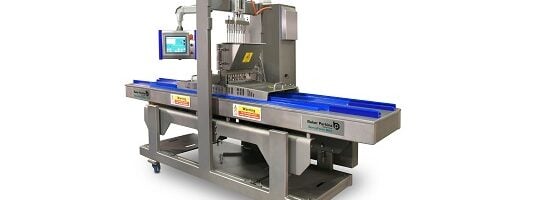
Baker Perkins’ expert range of jelly and gummy depositing systems are engineered with this challenge in mind, providing consistent nozzle temperatures and accurate depositing performance to reduce risk.
Starch-Free Depositing Benefits
Traditional gummy production processes rely on systems where product is deposited into starch-powder trays for setting and demoulding. However, starch-free depositing benefits for pharmaceutical-grade gummies are becoming increasingly sought after across the industry.
Starch-free systems eliminate the risk of starch contamination of the finished product, which is a concern for pharmaceutical-grade manufacturing where specifications are strict. They also remove the associated allergen risk (relevant for certain wheat-derived products), reduce the cleaning burden between products, and allow for faster, more hygienic production.
For manufacturers producing functional gummies to Good Manufacturing Practice (GMP) or pharmaceutical standards, starch-free depositing has now become a standard part of the process. Functional and medicated confectionery systems are designed around starch-free principles, for high standards of purity and control.
Adding Ingredients and In-Line Dosing
The order in which ingredients are introduced into the system has a direct impact on active ingredient pectin gummies stability.
Heat sensitive actives should be added as late in the process as possible, ideally after cooking, via in-line dosing systems. This minimises their total thermal exposure. Similarly, any ingredients with known interactions (such as calcium ions and some polyphenols) should be sequenced to prevent reacting too early.
Modern functional gummy manufacturing equipment supports in-line dosing of sensitive actives at the depositing stage, giving flexibility without compromising efficiency.
Water Activity and Moisture Control
Active ingredients, such as some probiotic cultures and vitamins, are sensitive to moisture. The final water activity of the product must be tightly controlled, as it can cause degradation and reduce shelf life. Consistent cooking and controlled cooling procedures, combined with the right packaging, are the best way to manage moisture.
How to Make Gummies That Deliver on Their Claims
Understanding how to make gummies that genuinely deliver their stated active ingredient levels requires a solid setup – from raw material selection and formulation through to equipment selection and packaging.
Key steps include:
- Selecting the right pectin type (HM or LM) based on the target sugar content and active ingredient pectin gummies compatibility
- Choosing confectionery manufacturing equipment that supports high-tech production and accurate dosing
- Adding acid as late in the process as possible
- Controlling and validating cooking temperatures for heat sensitive actives
- Partnering with equipment suppliers who understand the manufacturing process and regulatory demands of products
Why Choose Baker Perkins Products for Functional Gummy Manufacturing
Baker Perkins has over 100 years of engineering expertise across the global food manufacturing industry. As part of the Hillenbrand portfolio of best in class technology brands, we combine confectionery process knowledge with continuous investment in innovation.
We offer starch-free depositing systems, temperature control for heat sensitive ingredients, solutions for gelatin and pectin creations, and expert guidance from concept through to production.
Whether you’re scaling an existing product or developing a new pectin gummy, we provide the equipment and knowledge to help you bring a stable, effective product to fruition.
Explore more of our confectionary products or contact our team to discuss your production requirements.
FAQs
How much active ingredient is lost during the gummy manufacturing process?
This varies considerably depending on the ingredient and the process conditions. Heat sensitive vitamins, such as vitamin C, can degrade by as much as 20–40% during cooking if temperatures and timings are not carefully managed.
What is pre-gelation in pectin depositing, and why does it matter?
Pre-gelation occurs when the pectin mass begins to set before it has been deposited into the mould. This can happen within the depositing nozzle if temperature control or process dwell times are not well managed. The result is blocked nozzles and product loss. Preventing pre-gelation in pectin depositing nozzles is directly addressed by the design of Baker Perkins’ depositing systems.
What are the advantages of starch-free depositing for pharmaceutical-grade products?
Starch-free depositing eliminates the risk of starch contamination in the finished product, which is particularly important in pharmaceutical and nutraceutical uses. It also improves hygiene and simplifies cleaning in GMP manufacturing environments.
Can pectin gummies be produced at high output without compromising active ingredient stability?
Yes! With the right equipment and process design, they certainly can. Systems engineered specifically for pectin-based products, with short dwell times and accurate temperature management, can maintain active ingredient integrity at commercial production speeds.
What is the difference between HM and LM pectin in functional gummy formulation?
High Methoxyl (HM) pectin requires a high sugar concentration and low pH to gel, making it suitable for traditional confectionery but less compatible with reduced-sugar formats. Low Methoxyl (LM) pectin gels in the presence of calcium ions and can be used across a wider range of sugar levels, making it more flexible. The choice between the two will depend on the product specification and active ingredients being used.
Does equipment choice affect the ability to achieve label claims for active ingredients?
Choosing the right equipment is critical in achieving active ingredient pectin gummies stability. Systems that offer temperature control, minimal hold times, accurate dosing, and starch-free depositing give the greatest control over conditions that affect ingredient integrity.