With growth of the gummy market on an ever increasing trajectory, you may be looking into the nuances of pectin vs gelatin in industrial production to help you choose the best option. While both ingredients can create high-quality products, how they behave at scale creates very different challenges, and knowing the differences can support a smoother production and higher quality result.
Understanding pectin vs gelatin scaling issues is critical when optimising the gummy manufacturing process, particularly when working with modern confectionery production lines and depositor systems.
What’s the Difference Between Pectin and Gelatin?
At a formulation level, gelatin and pectin create very different textures and require specific processing conditions.
- Gelatin delivers a classic chewy, elastic texture and sets through cooling
- Pectin is typically used in plant-based recipes and forms a gel through a combination of sugar concentration, pH level, and temperature control
These differences may seem straightforward at a small scale, but significant complexity is introduced when scaling confectionery depositing systems.
What Are the Considerations for Gelatin in Large-Scale Use?
Gelatin has long been the gelling agent of choice for gummy production due to its forgiving nature during manufacturing. However, it comes with challenges at an industrial scale that you may find difficult to manage.
Key Scaling Considerations
- Temperature Control
Gelatin has to stay within quite a tight temperature range to maintain flow properties. Make it too hot, and the structure weakens; too cool, and viscosity increases, which can affect accuracy. - Viscosity Stability
Consistent thickness is essential for precise product creation in a gummy depositor. Variations can lead to weight discrepancies, and impact product quality and compliance, particularly in regulated markets.
- Longer Setting Time
Gelatin requires cooling to set, which can extend production cycles. Despite these factors, gelatin remains relatively stable during high-speed depositing. This makes it well-suited to large scale confectionery depositors when process conditions are well controlled.
What Are the Considerations for Pectin in Large-Scale Use?
Pectin offers clear advantages for plant-based and clean-label products, but introduces more demanding process requirements when scaling.
Key Scaling Considerations
- Precise Acidification
Pectin relies on pH to set, making acid addition techniques for consistent pectin setting at scale important. The problem with this is, poor control can result in premature setting or incomplete gel formation.
- Narrow Process Window
Unlike gelatin, pectin has a much tighter operating window to get it right. Small deviations in temperature or pH can significantly affect product quality.
- Rapid Setting
Pectin begins to set quickly once deposited, which can be advantageous, but only if the depositing system is well optimised. Otherwise, it can lead to blockages or inconsistent fill.
HM Pectin vs LM Pectin for Sugar-free Gummy Production
There is more than one type of pectin, and choosing the right one for the job could be the difference between a smooth and successful product run, or a product that doesn’t bind well and clogs up machinery. View our comparison table to see the differences between HM pectin and LM pectin at a glance.
| HM Pectin (High Methoxyl) | LM Pectin (Low Methoxyl) |
| Requires a high sugar content and low pH | Can set with lower sugar levels using calcium ions, offering greater flexibility but precise calcium control |
| Typically used in traditional confectionery | Typically used in more modern health-conscious products and confectionery |
| Less suitable for sugar-free products | Ideal for sugar-free gummy products |
| Fast setting times | Setting times are longer than HM pectin |
For manufacturers targeting reduced-sugar or functional products, LM pectin is often the go-to choice, but it demands more thorough management of the process.
What Are the Depositing Challenges at Scale?
Whether using gelatin or pectin for your product, gummy depositing challenges become more pronounced as production volumes increase.
Flow Behaviour and Accuracy
In high-speed systems, even minor inconsistencies can lead to weight variation and shape defects, resulting in increased product waste. This is particularly true for functional and medicated products.
Equipment Design and Integration
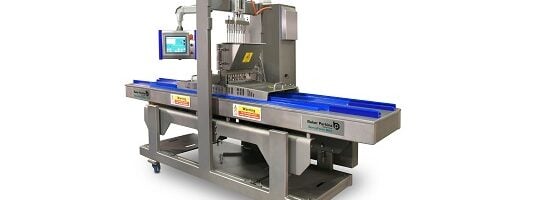
Modern confectionery production lines must accommodate near continuous cooking, accurate ingredient dosing, and controlled depositing conditions. Fully integrated systems such as gummy making machines reduce variability and improve repeatability across long production runs.
How to Scale Confectionery Depositing Systems Effectively
To successfully scale production, formulation must align with equipment capability. Several key considerations must be carefully managed to ensure consistent results.
- Controlled cooking systems with precise temperature and solids control play a central role in gelatin and pectin creations.
- Production is aided by precision depositing technology, where advanced confectionery depositor systems maintain consistent product weight, shape and structure at high production speeds.
- Recipe and process integration ensures the interaction between ingredients and equipment is fully optimised and streamlined.
- Hygiene and efficiency are a top priority. Processes are being sped up by fast cleaning and seamless product transitions, both increasingly important for multi-product lines.
Why Equipment Choice Matters
Selecting the right equipment partner is crucial when addressing pectin vs gelatin scaling issues in your production process.
Baker Perkins products are designed to:
- Handle both gelatin and pectin formulations with precision
- Maintain consistent depositing performance across production runs
- Eliminate unnecessary complexity, such as starch handling
- Support innovation in product design and formulation
With fully integrated solutions, manufacturers can scale efficiently while maintaining product quality and operational control.
Why Choose Baker Perkins
Baker Perkins combines over 100 years of engineering expertise with continuous innovation in food processing technology. As part of the Hillenbrand portfolio, we support leading global manufacturers across confectionery, bakery and snack sectors.
Manufacturers choose Baker Perkins for our proven performance in large-scale confectionery depositors, as well as fully integrated systems that streamline the manufacturing process. With industry-leading expertise in both gelatin and pectin-based production, alongside ongoing technical support and process optimisation, we deliver reliable, high-quality results.
From concept through to full-scale production, Baker Perkins helps manufacturers maintain efficiency and a strong competitive edge. Partner with Baker Perkins to master your production – contact our experts to discuss optimising your processes.
FAQs
What are the main differences in depositing pectin vs gelatin?
Gelatin relies on temperature-controlled cooling to set, making it more forgiving during depositing. Meanwhile, pectin requires precise control of pH and temperature, making it more sensitive but well-suited to plant-based products.
How do you prevent setting issues with pectin at scale?
Effective acid addition techniques for consistent pectin setting are essential. This includes controlled dosing systems and precise timing within the process to avoid premature setting.
Which is better for high-speed production: pectin or gelatin?
Gelatin is generally easier to handle at very high speeds due to its stability. However, with the right equipment and process control, pectin can also be successfully used in high-output systems.
Can one production line handle both pectin and gelatin recipes?
Yes, modern systems can be configured to handle both, provided they offer flexible control over temperature and depositing parameters.
What role does depositing equipment play in scaling?
Good equipment is the key to ensuring consistent product quality. Advanced systems maintain accurate flow, weight, distribution, and shape, even under demanding production conditions. Our range of products are precise and durable, helping you scale effectively.